
The HR skills that survive AI, and the ones that don’t

AI is now deep in the conversations in boardrooms, exec meetings, and operating model discussions. It’s behind questions like: Where can we automate? What could we do faster? Do we still need the same team structure? And, increasingly, what does this mean for HR itself?
Recently, our team at Solve co-hosted an event in Brisbane with our partners Humaneer and GoFIGR to unpack exactly that. It was a grounded conversation about what AI is already doing to HR work, which skills are becoming more valuable, and what people teams need to start building now.
GoFIGR brought the data, drawing on their AI Impact Model across 100 HR roles and more than 1,800 individual tasks. Humaneer brought the frontline HR reality, from building Mak, an AI platform purpose-built for HR work, to working closely with practitioners navigating this shift in real time.
The result? A clear message for HR and People leaders: Doing nothing is still a choice, and not a very good one.
AI is changing tasks, not jobs
One of the most useful reframes from the sessions was this: AI is not currently replacing whole HR jobs, but it is changing the tasks within them.
When conversations about AI jump straight to jobs disappearing, HR teams can end up stuck between panic and denial. But when you break roles down into the actual work being done, the picture becomes much clearer.
GoFIGR’s analysis looks at roles task by task, then maps how AI may affect each task across different adoption scenarios. Some tasks stay human, some become human-led with AI support, some are AI-led with human review, some can be fully automated, and some may disappear altogether because the surrounding work changes.
Their modelling also found that even if an HR Manager did nothing deliberate with AI, 83% of their tasks would be AI-impacted within as little as three years. While the role doesn’t disappear, the nature of the work changes.
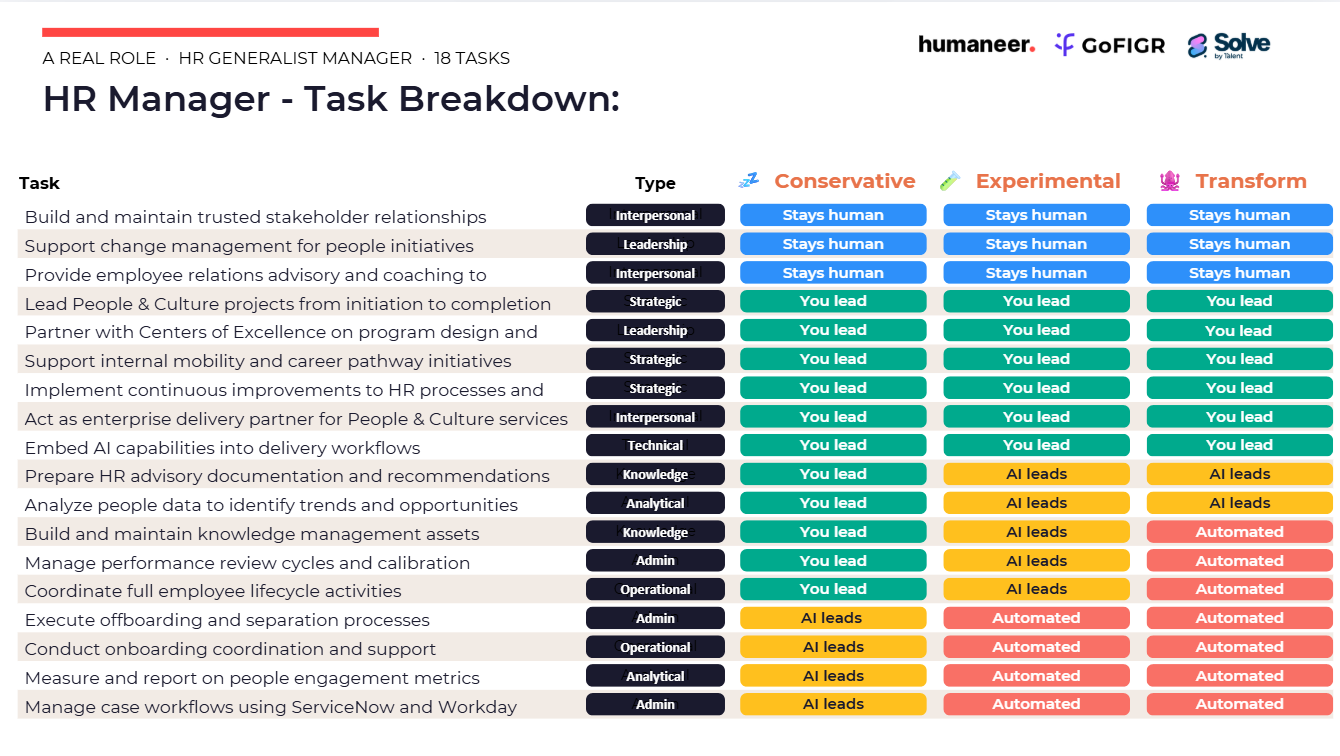

As Helena Turpin from GoFIGR put it, AI is currently “nibbling into the tasks that we do.” The risk and opportunity now depend on which tasks make up most of your role.
Administrative, repetitive and documentation-heavy work is where AI has the clearest impact. These are tasks like reporting, data, entry, scheduling, drafting, documentation and systems admin; all areas where AI can already do a lot of the heavy lifting.
However, interpersonal, strategic and judgement-heavy work is proving far more durable. This covers coaching, influence, employee relations, change leadership, ethical judgement and stakeholder management. And as the routine work starts to fall away, these will become even more important.
The value of HR is shifting from output to judgement
For years, HR teams have often been measured by the volume of work they produce: the number of policies written, letters drafted, reports sent, cases documented, processes complete… AI changes this model.
If technology can handle the more menial tasks, the value of HR then moves to the quality of the thinking behind the work, the judgement applied, the context that shapes it, and the human accountability wrapped around it.
Kimberly Burns from Humaneer captured the shift clearly in the session: The work that has traditionally made HR feel busy is not necessarily the work that will make HR valuable in an AI-enabled environment.
While operational work will still matter, it means HR teams need to be more deliberate about where human capability is best utilised.
The future-fit HR professional will not just be someone who can produce the work, but someone who can ask whether the work is right, fair, compliant, useful and aligned to the business problem in front of them.
That is a much higher-value skillset.
The skills that survive are deeply human
The strongest HR skills in an AI-enabled world are not soft in the fluffy sense. They’re human, commercial and difficult to automate.
Across the discussion, several durable skills stood out:
- Coaching and influence: As managers and employees navigate new ways of working, HR’s ability to guide, challenge and influence will become more valuable, not less.
- Employee relations and judgement: AI can support documentation and surface risk, but complex people matters will still need context, discretion and accountability.
- Change leadership: Someone needs to help the organisation adopt AI in a way that is practical, ethical and human. HR is well-placed to play that role, but only if it builds the capability to lead the conversation.
- Stakeholder management: AI may accelerate work, but it doesn’t remove the need to bring people with you.
- Business understanding: Generic AI outputs are only useful if someone can interpret them in the context of the organisation and its workforce, risk profile and strategy.
For us, this is where the conversation gets interesting. The future of HR is about talent advisory, operating model design, workforce planning, and helping businesses make sharper decisions about people, process and technology.
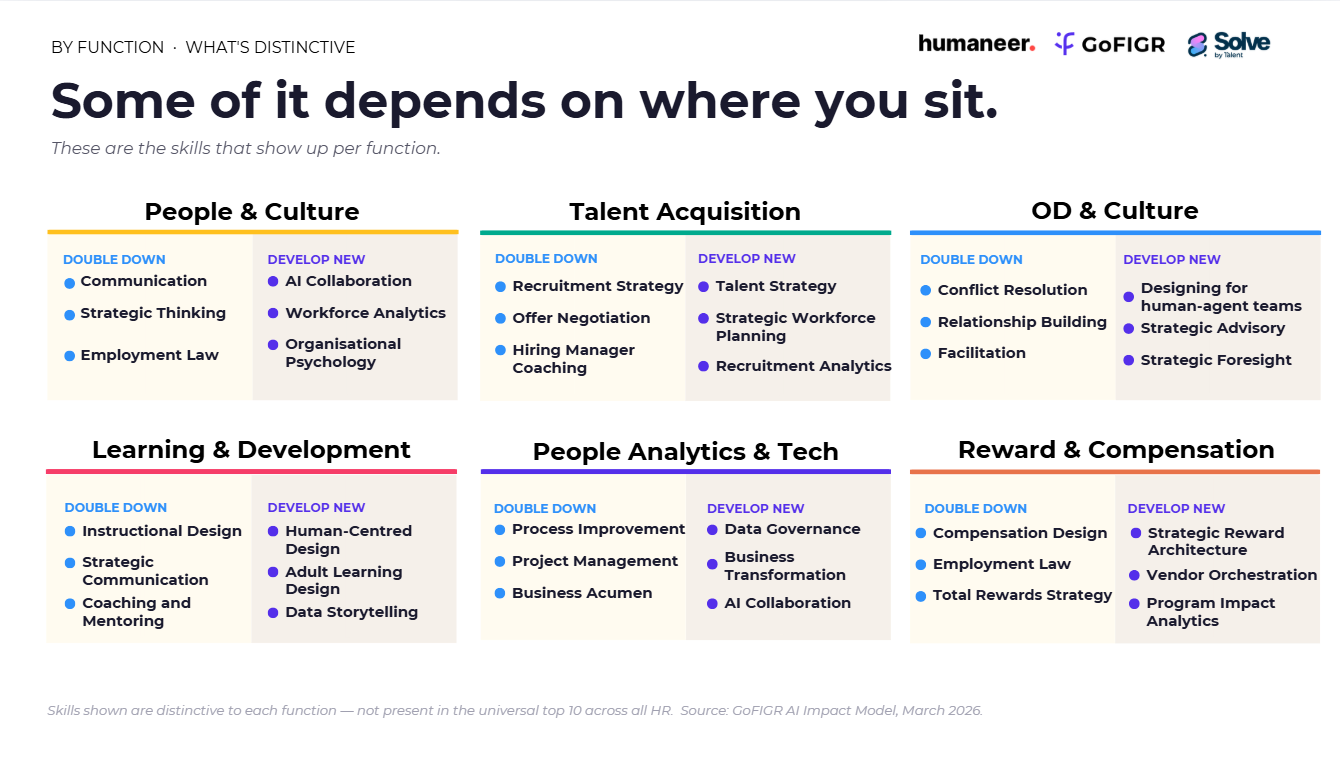
The skills that HR and People teams need to build now
While some skills become more valuable, others are emerging quickly.
The session highlighted a set of capabilities HR teams will need to start building, especially as AI moves from experimentation to deeper workflow integration.
- AI output evaluation: HR professionals need to know how to review AI-generated work, spot errors, challenge assumptions and identify hallucinations before they become real-world risk.
- Workflow orchestration: As AI tools and agents become embedded in work, HR will need to understand how human and AI tasks fit together across processes.
- AI governance and ethical decision-making: HR cannot afford to treat AI as a purely technical issue. Decisions about automation, workforce design, fairness, privacy and accountability are people decisions.
- Strategic people analytics: As more workforce data becomes available, HR will need to turn insight into action, not just produce dashboards.
- Human-centred work design: If AI changes how work gets done, HR has a major role to play in redesigning roles, teams and career pathways around that new reality.
And these aren’t skills most teams can build through a single lunch-and-learn, they require practice, exposure and a shift in how HR sees its own role.
The skills that decline aren’t useless, but they are less differentiating
Administrative and reporting skills still matter, and HR will always need accuracy, compliance and operational discipline.
But as AI takes on more execution-heavy work, these skills become less differentiating.
Documentation, reporting, scheduling, systems administration and basic drafting are all areas where AI can increasingly support or lead. For HR teams, the question is not whether this work matters, but whether this is where humans should continue to spend most of their time.
This is especially important for HR leaders thinking about team structure, career pathways and capability investment. If AI is likely to absorb more of the traditional entry-level or admin-heavy workload, then HR will need to be much more intentional about how people learn.
The old pathway of “start with admin, build experience, then move into advisory work” may not hold in the same way. Early-career HR professionals will still need development pathways, but those pathways may need more shadowing, project work, judgement-building, stakeholder exposure and AI review capability much earlier.
As Helena noted in the discussion, if organisations automate away all the work that helps junior people learn, they risk eating their seed corn. It may look efficient today, but it weakens tomorrow’s capability pipeline.
Safe experimentation beats doing nothing
One of the clearest takeaways from the event was that HR does not need to redesign the entire function overnight.
In fact, trying to do everything at once is probably the wrong move.
The better starting point is targeted and safe experimentation. Look for workflows where AI can reduce low-value work without handing over high-risk judgement. Start with tasks that are repetitive, time-consuming and well understood. Use AI to create headspace, then reinvest that headspace into higher-value capability.
That might mean using AI to draft documentation, summarise case notes, support policy interpretation, analyse workforce data or structure manager guidance. But it also means keeping humans accountable for final decisions, especially in high-risk people matters.
Kimberly shared a useful warning from her own testing of generic AI tools: they can sound extremely confident even when they are wrong, and that’s a serious issue in HR, where context, legislation, jurisdiction and risk matter.
The lesson is: Use AI deliberately, safely and with the right guardrails.
HR needs to be in the room
The biggest takeaway was this: AI decisions are already being made in organisations.
If HR isn’t actively involved, those decisions will still happen, but without the people function shaping them. And that’s where the problem lies.
AI is not just a technology issue but an issue that involves workforce, capability, culture, role design, leadership and change.
In other words, it’s very much an HR issue.
As AI changes work across the business, HR has two jobs to do at once:
- Understand how AI will change its own function
- Help the broader organisation make better decisions about people, skills and work design
This might feel like a big ask, but it’s also a major opportunity.
HR teams have spent years asking for a more strategic seat at the table and AI may be one of the clearest chances to claim it, provided HR can move beyond reacting and start leading.
The takeaway for HR and People leaders
AI could be used to strip teams back, reduce cost and automate work without much thought for capability, culture or long-term workforce health.
Or it could be used to elevate the HR function, helping teams focus on the work that actually moves the business forward.
The difference comes down to how organisations now choose to respond.
For HR leaders, the next step is not to panic or wait, but to get specific:
- Break roles down into tasks
- Identify where AI can safely support the work
- Protect the human capabilities that matter
- Build the new skills your team will need
And ultimately make sure HR is in the room when AI decisions are being made because doing nothing is a choice and, in this very moment, HR has a much better one.












Get in touch.